Protect growth.
Make room for the regulatory requirement while preserving the new-market launch and sales channel expansion.
Gives way
- Defer Service continuity programme
- Defer Finance modernisation

Most organisations have more worthwhile work than they can support.
Priorities compete, different kinds of value are hard to weigh, and existing commitments limit what else can be supported.
TransparentChoice helps leaders see how different priorities change which commitments stay, which give way and the business consequences.
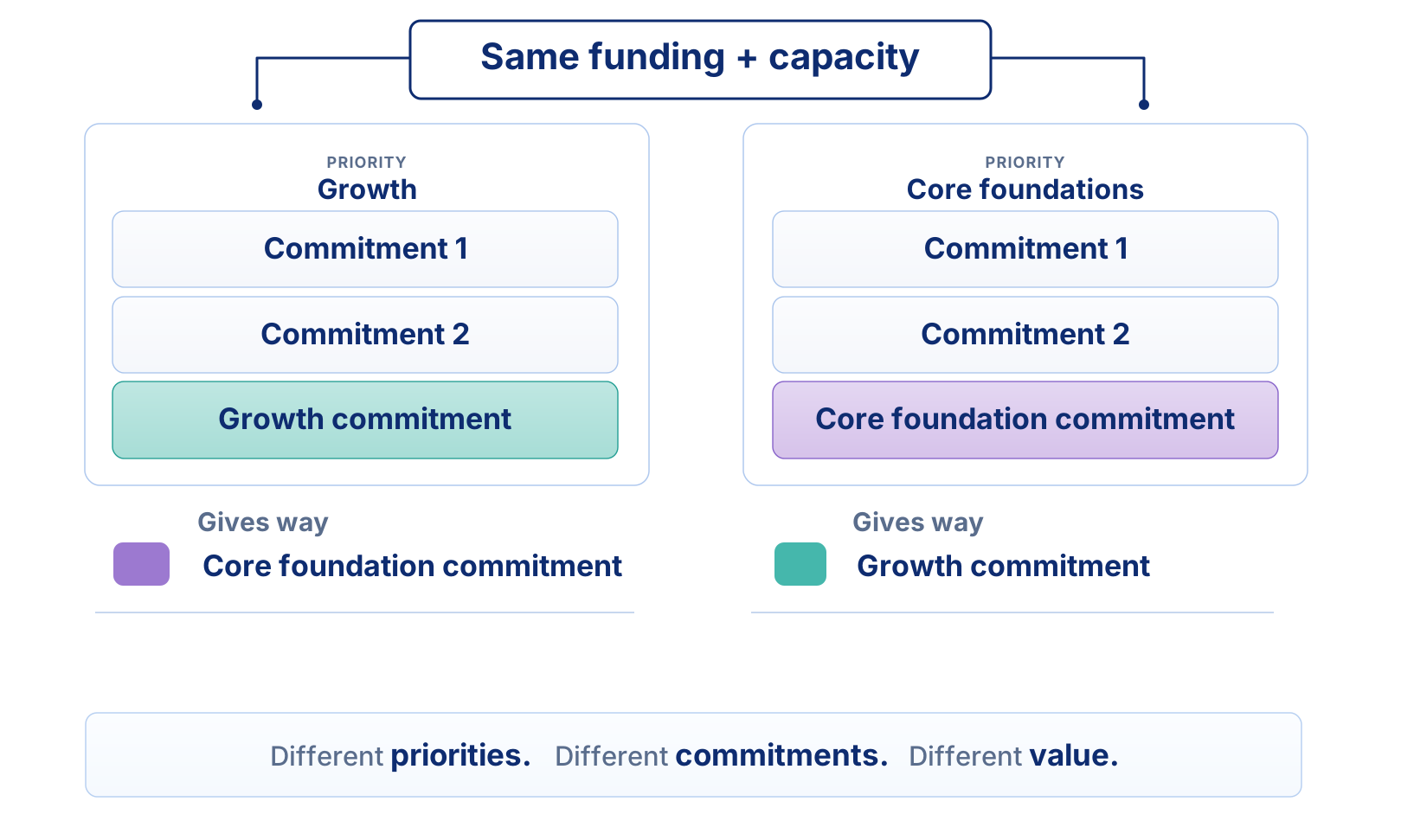
The same funding and capacity can produce very different business value, depending on what they support.
When priorities, funding or capacity change, test whether the decision still holds.
The decision
When competing commitments cannot all be supported with the available funding and capacity, several workable combinations may still fit.
Leadership must decide what to protect and what gives way.
This choice can arise when setting a portfolio or reconsidering existing commitments.
Illustrative example
Existing commitments already use the available investment funding and change capacity.
New requirement
A new regulatory requirement must be met.
Same requirement. Same constraints. Two workable choices.
Protect growth
Gives way
Protect core operations
Gives way
Make room for the regulatory requirement while preserving the new-market launch and sales channel expansion.
Gives way
Make room for the regulatory requirement while preserving service continuity and finance modernisation.
Gives way
Both choices fit the same available funding and change capacity.
What gives way depends on how leadership values growth relative to core operations. TransparentChoice is designed for decisions of this shape: it makes those priorities explicit, applies them alongside funding and capacity constraints, and shows what stays and what gives way.
The same decision can arise in planning, funding, transformation or governance, within a business unit, a region, a major programme or across the enterprise. Once funding and capacity are committed, existing work keeps them until leadership changes the choice.
Why the choice matters
Leadership is deciding where scarce funding and capacity go, not just whether each initiative is worthwhile. Different commitments made with the same resources can deliver different business value.
How TransparentChoice helps
TransparentChoice makes the priorities, assumptions, constraints and dependencies behind the choice explicit.
Use structured comparisons to capture leadership priorities, test them for consistency and see whether different views change what stays and what gives way.
Apply leadership priorities alongside funding, capacity, mandatory constraints and dependencies to compute the resulting portfolio: what stays, what gives way and the business consequences.
Change priorities, assumptions or constraints and recompute the portfolio to see what changes and what would produce a different result. When circumstances change, test whether the earlier choice still holds.
Leadership defines what matters and makes the final decision.
Works with what you already use. Portfolio information does not settle every trade-off. TransparentChoice sits alongside planning, analysis, governance and PPM/SPM to test how leadership priorities change feasible portfolio choices.
Customer results
3–4 credible portfolio options
RNLI
Leaders compared credible portfolios under constrained specialist capacity. When priorities changed, they reweighted the criteria and rapidly rebalanced the portfolio.
View case study →€200m decision
Stockholm Subway
Teams brought financial, technical and integration considerations into one transparent process, iterating on criteria and weightings before the go/no-go decision.
View case study →2× portfolio ROI
American Planning Association
Leadership focused resources on initiatives that advanced strategy, doubling portfolio ROI.
View case study →Trusted By